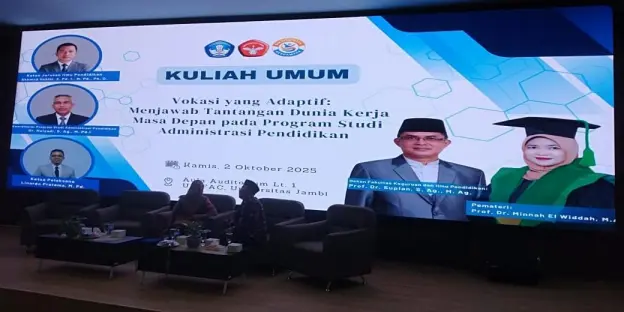
Prof. Minnah El Widdah Discusses Adaptive Vocational Education in a Public Lecture at FKIP Unja
Muaro Jambi – Professor Dr. Minnah El Widdah, M.Ag, a lecturer from the Faculty of Tarbiyah and Teacher Training at UIN Sulthan Thaha Saifuddin Jambi, served as a guest speaker at a public lecture organized by the Faculty of Teacher Training and Education, University of Jambi, on Thursday (October 2). The event carried an important and relevant theme: “Adaptive Vocational Education: Responding to the Challenges of the Future Workforce.”
The presence of Prof. Dr. Minnah El Widdah brought a unique touch to the event. She currently serves as the Vice Dean II of the Faculty of Science and Technology at UIN Sulthan Thaha Saifuddin Jambi. In her presentation, she emphasized the importance of the concept of adaptive vocational education as a response to the changing times.
According to her, adaptive vocational education is an educational approach that focuses on developing students’ skills and competencies. Through this strategy, students are expected to become competent and adaptable professionals—an essential quality in today’s increasingly dynamic job market.
Furthermore, Prof. Minnah highlighted that the challenges of the future workforce include technological transformation, global competition, and the growing demand for relevant skills. Therefore, higher education institutions must prepare graduates who are flexible and ready to face these transformations.
She went on to explain the benefits of adaptive vocational education, which include improved job readiness, competitiveness, flexibility, productivity, and job satisfaction. In addition, adaptive vocational education can also help reduce the skills gap and foster innovation.
To face these challenges, Prof. Minnah shared several key principles for students to uphold. These principles include patience and reliance on God (tawakal), continuous skill development, pursuit of knowledge, and the courage to take risks.
She also underscored the crucial role of educational administration as a bridge between the world of education and the world of work. According to her, educational administration should function as an enabler that supports cross-sector collaboration.
In this regard, the Educational Administration Study Program of the Faculty of Teacher Training and Education (FKIP) at the University of Jambi has implemented various innovative strategies. These include the use of information technology, data-based management systems, and the strengthening of both student and faculty capacities. Additionally, the curriculum is designed to align with the needs of society and the labor market.
At the end of her presentation, Prof. Minnah delivered a special message to students. She encouraged them to develop dual competencies—educational management skills and practical vocational abilities.
Thus, university graduates are expected not only to be ready for the workforce but also to serve as agents of social change. Their presence in society is hoped to bring positive impacts on the nation’s development in the future.